When to Quit Your Job for a Side Hustle 7 Proof Points
When to Quit Your Job for a Side Hustle: The 7 Proof Points You Must Hit First
By Tracy Brinkmann
------------------
TL;DR
Quitting your day job should never be based on frustration or a single profitable month—it requires verifiable operational proof. Before making the leap, calculate your survival number versus your replacement number, then evaluate your venture against seven objective proof points (covering stranger sales, income consistency, client concentration, and runway). If critical safety metrics show red, spend the next 30 days fixing one bottleneck while keeping your steady paycheck intact.
Free Episode 566 Freebie
The Proof-Before-You-Quit Scorecard
Find your survival number, rate your 7 proof points, and see if you're red, yellow, or green before you hand in notice.
Get the Free ScorecardWe have all indulged in the fantasy: walking into your boss’s office, dropping your security badge on the desk with a cinematic one-liner, and exiting to your own mental soundtrack.
That feeling delivers an incredible rush—for about three weeks. Then the first month arrives without a corporate paycheck. You suddenly discover that the side hustle that netted a few hundred bucks last month did not represent a sustainable enterprise; you merely had one lucky stretch.
Quitting is not the starting line of entrepreneurship—proof is.
Drawing insights synthesized by the host of The Dark Horse Entrepreneur, who analyzed the journeys of real-world operators—including financial creator Charlie Chang, Bulldog Gin founder Anshuman Vora, corporate dropout-turned-business-owner Poppy (Reinventing Poppy), and Steven Bartlett (The Diary of a CEO)—this guide outlines the exact framework required to turn your exit strategy from a dangerous gamble into an evidence-backed transition.
Key Takeaways
Fuel vs. Map: Sunday-night dread tells you that you want to leave your job, but it offers zero evidence that your side hustle can carry your living expenses.
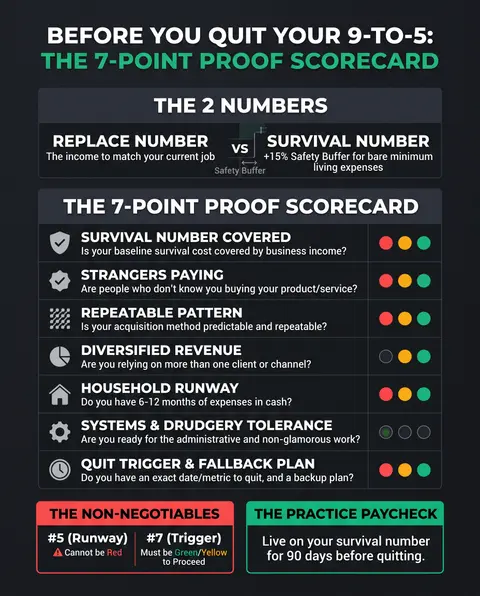
Two Mandatory Numbers: Calculate your Replacement Number (what your day job pays) and your Survival Number (bare-bones monthly overhead plus a 15% safety buffer).
The 7 Proof Points: Score yourself using Green, Yellow, and Red across seven areas: survival coverage, stranger revenue, repeatable patterns, client diversification, household runway, task tolerance, and an exit trigger with a fallback plan.
Non-Negotiables: Never quit if your Runway or your Trigger/Fallback are scored Red.
The Practice Paycheck: Live strictly on your baseline survival number for three consecutive months while still employed to stress-test your budget and bank your remaining salary.
The Two Critical Numbers You Must Know Before Quitting
Before evaluating customer demand or setting a resignation date, you need complete clarity on two distinct financial baselines (a calculation popularized by educator Charlie Chang). Most aspiring founders track only one, creating an expensive blind spot.
+--------------------------------------------------------------------------+
| 1. REPLACEMENT NUMBER                                                    |
| The gross figure required to fully match your current 9-to-5 salary.      |
| Example: $60,000/year = ~$1,200/week (~$30/hour at 40 hours/week).       |
+--------------------------------------------------------------------------+
| 2. SURVIVAL NUMBER                                                       |
| Bare-bones baseline costs (mortgage/rent, food, transit, health care,    |
| utilities) + a mandatory 15% safety buffer.                              |
| Example: $2,175 base expenses + 15% ($325) = ~$2,500/month (~$600/week). |
+--------------------------------------------------------------------------+
Notice the massive spread: in this baseline scenario, surviving takes roughly $600 per week, whereas complete replacement requires $1,200 per week.
-
Quitting the minute your side hustle pays a single utility bill is reckless optimism.
-
Assuming you cannot leave until you replace 100% of your executive salary is often an unnecessary delay.
Knowing this gap allows you to make an objective, grown-up decision. And while you calculate and test these figures, remember Charlie Chang's cardinal rule: keep the day job. There is almost always a lag between putting in the labor and receiving customer cash.
The 7 Proof Points: Are You Red, Yellow, or Green?
This scorecard removes emotional guesswork. You do not award yourself arbitrary points; instead, assign each category a simple status:
-
Green: Backed by concrete, real-world data and sustained results.
-
Yellow: Early signals exist, but data is thin, inconsistent, or tied to a single lucky break.
-
Red: The metric is entirely unproven or missing.
                THE 7 PROOF POINTS SCORECARD
┌─────────────────────────────────┬───────┬────────┬─────┐
│ Proof Point                     │ Green │ Yellow │ Red │
├─────────────────────────────────┼───────┼────────┼─────┤
│ 1. Survival Number Covered      │ [   ] │ [   ]  │ [ ] │
│ 2. Strangers Are Paying You     │ [   ] │ [   ]  │ [ ] │
│ 3. Consistency (Repeatable)     │ [   ] │ [   ]  │ [ ] │
│ 4. Client Diversification       │ [   ] │ [   ]  │ [ ] │
│ 5. Household Runway             │ [   ] │ [   ]  │ [ ] │
│ 6. Operational Drudgery & SOPs  │ [   ] │ [   ]  │ [ ] │
│ 7. Defined Trigger & Fallback   │ [   ] │ [   ]  │ [ ] │
└─────────────────────────────────┴───────┴────────┴─────┘
Proof Point 1: Survival Number Coverage
Has your venture reliably generated enough profit to clear your baseline survival expenses—not just for a single weekend, but over a consecutive sequence of months?
-
Green: Side hustle net profits have covered your full survival number for several consecutive months.
-
Yellow: Your side revenue covers a fraction of the baseline, or cleared it only once during a peak period.
-
Red: You do not know your exact financial metrics yet, or income is negligible. (Note: This is the easiest red to resolve—sit down with a calculator tonight.)
Proof Point 2: Unbiased Stranger Revenue
Pity purchases from family, friends, and former coworkers do not validate market demand. As Charlie Chang notes, completing your first two or three client projects for free in exchange for detailed testimonials is a reasonable way to build social proof. But that is merely a warmup.
Genuine validation occurs when an absolute stranger—someone who owes you nothing and does not know your name—reviews your offer and pulls out their credit card.
Furthermore, monitor your pricing power. When Chang began his tutoring service, he started at $25–$30 per hour and steadily increased rates to $50–$60 per hour as client reviews stacked up. Your opening rate is the lowest you will ever charge; stagnant prices suggest weak underlying demand.
-
Green: The majority of your revenue comes from people outside your personal network, and you have successfully raised prices at least once.
-
Yellow: A handful of strangers have converted, but your primary revenue still relies on your inner circle.
-
Red: All sales stem from family, friends, or polite social promises ("I'll definitely buy when it launches").
Proof Point 3: Predictable, Repeatable Tractions
One isolated surge in revenue is a spike; consistent performance across varied conditions is a pattern.
Former banker and Bulldog Gin founder Anshuman Vora offers a crucial reminder: it always takes longer to get up and running than you expect.
Similarly, Steven Bartlett (The Diary of a CEO) illustrates audience and business growth as an unpredictable cycle: you climb, plunge into what he terms "Death Valley" for several months, experience an unexpected surge, and drop back into a trough.
If your business has only experienced the upward climb, you do not yet know how it performs during a downturn. You want to weather that first valley while a steady employer paycheck covers your living costs.
       TYPICAL GROWTH TRAJECTORY (THE "DEATH VALLEY" CYCLE)
Revenue
  ^       /\ (Spike)
  |      /  \               /\ (New High)
  |     /    \             /  \
  |    /      \___________/    \___________
  |   /       [Death Valley]   [Leveling Off]
  +---------------------------------------------> Time
-
Green: Several stable months of operations, including at least one severe seasonal or market dip survived, with clear documentation showing where leads originate.
-
Yellow: Top-line revenue looks promising but swings wildly, and you cannot clearly pinpoint what drives lead acquisition.
-
Red: You had one explosive launch or viral event that you have been unable to replicate.
Proof Point 4: Broad Revenue Diversification
Relying predominantly on a single client, one enterprise contract, or a single platform's algorithm does not make you a business owner—it makes you an employee without corporate labor protections.
If that single agency slashes its budget, an executive changes, or a platform alters its distribution rules, your revenue can plummet to zero overnight. A stool supported by only one leg is just a stick.
-
Green: Revenue is balanced across multiple distinct clients or organic channels; no single source makes up the majority of your cash flow.
-
Yellow: One dominant client accounts for most earnings, but secondary accounts are steadily expanding.
-
Red: A single buyer, agency contract, or platform algorithm generates virtually all your business income.
Proof Point 5: Agreed-Upon Family Runway
Runway is the number of months your household can maintain basic operations if business revenue halts entirely.
Vora strongly advises against quitting on impulse to "figure things out as you go" unless you possess independent wealth, emphasizing that financial panic heavily impacts spouses and children.
However, your runway does not rely solely on cash reserves. As demonstrated by Poppy (Reinventing Poppy), who exited corporate life at age 38, taking an intentional 38% pay cut can succeed if you aggressively lower fixed overhead, especially housing. Every dollar eliminated from your baseline expenses lowers your required survival number.
-
Green: You have fully funded your designated liquid reserve, and your partner or family formally agrees on the exact cash cushion.
-
Yellow: Your emergency savings are partially funded, supported by a clear, active plan to cut household expenses.
-
Red: A single zero-revenue month would compromise your ability to pay essential bills.
Proof Point 6: Drudgery Tolerance and Documented SOPs
Many aspiring founders trade a 40-hour workweek for a 24/7 treadmill because they fail to account for operational friction.
Poppy shares two realities rarely discussed by the "quit your job" community:
-
Every business entails tasks you will actively dislike. If you refuse to handle them yourself, you must hire help, which increases overhead and erodes margins.
-
When an office pipe bursts at your corporate job, you clock out and go home to sleep. When a pipe bursts in your own facility, fixing the disaster rests entirely on you.
Steven Bartlett labels the ability to push through unglamorous administration "drudgery tolerance" or "boredom tolerance." This means executing repetitive tasks—customer service, invoicing, filing—when nobody is applauding.
While AI tools excel at drafting checklists, cleaning up customer notes, and assembling templates, they cannot operate your company for you. In high-stress environments, operators do not rise to the occasion; they sink to the level of their operational training and standard operating procedures (SOPs).
-
Green: Core fulfillment and admin processes are written down as clear SOPs, and you have executed the mundane operational tasks for months without dropping them.
-
Yellow: Workflows live almost entirely in your head, and you find yourself avoiding backend administration in favor of creative tasks.
-
Red: If an illness took you offline for seven days, all customer delivery and operational income would grind to a halt.
Proof Point 7: A Defined Exit Trigger and Fallback Plan
Quitting should never be governed by a vague, moving goalpost ("I'll leave when the timing feels right"). It requires a documented trigger and a concrete Plan B.
When Vora launched Bulldog Gin, he raised initial capital from friends under a strict escrow arrangement: he committed to quitting his banking position within roughly 90 days of launch or returning their investments in full. He worked nights and weekends while maintaining his day job until that milestone arrived.
Establish an equally strict threshold for yourself, both for your exit and for an emergency pivot:
Exit Trigger:
Side Hustle Profit > Survival Number for 3 Consecutive Months + Full Runway Secured
Fallback Trigger:
Post-Exit Income < Survival Floor for X Months ==> Contract/Freelance/Re-enter Workforce
Do not burn bridges with your employer on your way out. Former managers and colleagues frequently become an entrepreneur's highest-paying early consulting clients or primary referral sources.
-
Green: Both your formal exit criteria and your emergency fallback plan are committed to paper and agreed upon by your household.
-
Yellow: You hold general benchmarks in your head, but no strict thresholds or contingency timelines are written down.
-
Red: Your entire strategy relies on the hope that your venture "simply has to work."
Evaluating Your Scorecard: What to Do in the Next 30 Days
Review your distribution of Green, Yellow, and Red marks:
+--------------------------------------------------------------------------+
| THE HARD STOP RULE:                                                      |
| Regardless of other scores, if Point 5 (Runway) or Point 7 (Trigger &     |
| Fallback) is RED, you are NOT ready to quit. These two represent the     |
| absolute structural floor protecting your household.                    |
+--------------------------------------------------------------------------+
-
Predominantly Red: You are in the foundational phase of your business. As Charlie Chang notes, low-overhead service businesses primarily risk your personal time and evening energy—not your retirement assets. Build quietly while collecting your corporate paycheck.
-
A Mix of Yellow and Green (with 1–2 Reds): You are approaching viability. Your objective over the coming quarter is converting remaining Reds to Yellows.
-
Predominantly Green: You have verified operational viability. Schedule a dedicated conversation with your household partners, review the numbers together, and formally circle a calendar date.
Your 30-Day Action Plan
Do not attempt to fix every bottleneck simultaneously. Trying to overhaul seven distinct operational systems on top of a 40-hour workweek leads straight to exhaustion.
Select one single Red metric and dedicate the next 30 days exclusively to that gap:
-
If Red on Survival Numbers: Audit your household spending tonight. Calculate your survival expenses plus the 15% buffer.
-
If Red on Paying Strangers: Secure three client sales from people outside your personal network, or execute two free pilot projects strictly in exchange for documented case studies.
-
If Red on Tractions: Audit your existing customer base to identify the specific marketing channel that produced them.
-
If Red on Client Diversification: Actively prospect outside your primary client account or explore secondary acquisition channels.
-
If Red on Runway: Establish an automated bank transfer this week to build reserves, or audit your monthly statements to trim a recurring expense.
-
If Red on Daily Operations: Document your five-step delivery workflow from start to finish and assemble a simple SOP.
-
If Red on Exit Triggers: Draft your exact conditional parameters: "When my business achieves [X income] for [Y months], I give notice. If revenue drops below [Z] for [N months], I activate my fallback plan."
The "Practice Paycheck": The Ultimate Reality Check
To test your readiness without risking your livelihood, run this operational trial:
-
Establish Firewalled Accounts: Set up a dedicated commercial bank account for your side hustle. Every dollar of revenue must flow exclusively into this account.
-
Impose the Survival Constraint: For the next 90 days, restrict your personal household spending to your calculated Survival Number—ignoring your excess day-job salary.
-
Automate the Remainder: Route every dollar of your paycheck above that survival threshold directly into a separate liquid savings account.
This three-month trial yields three critical benefits:
-
It forces you to fund your emergency runway rapidly.
-
It exposes whether your survival calculations were accurate or unrealistically optimistic.
-
It provides a low-risk simulation of your post-exit lifestyle while your employer still covers core benefits and base pay.
If living on your baseline budget feels sustainable, you have earned genuine confidence. If it proves stressful, you gain invaluable diagnostic data—months before handing in your badge.
Frequently Asked Questions
Can I quit my day job if my side hustle matches my baseline survival number?
Not immediately. Meeting your survival number for a single month is not enough proof to leave your day job. Net profits from your venture should cover that survival number (plus a 15% contingency cushion) for several consecutive months. Additionally, you must have an agreed-upon household cash runway and a written fallback plan in place before stepping away from your primary salary.
How much cash runway do I need before leaving my 9-to-5?
There is no universal dollar figure because personal overhead varies dramatically. However, a safe runway typically covers several months of household survival expenses. You can extend this cushion either by banking liquid savings or by taking deliberate steps to lower fixed living costs (such as housing or recurring subscriptions) before resigning.
What is the difference between a replacement number and a survival number?
Your replacement number is the gross compensation required to match your current employment salary dollar-for-dollar. Your survival number is the absolute minimum capital required to pay non-negotiable monthly expenses—housing, basic food, debt obligations, health insurance, and utilities—plus a 15% safety buffer.
What is "drudgery tolerance" in entrepreneurship?
Coined by Steven Bartlett (The Diary of a CEO), drudgery tolerance (or boredom tolerance) is the willingness to execute the unglamorous, administrative, and repetitive tasks required to keep a company operational—such as bookkeeping, customer support, and system documentation—when no one is watching or offering praise.
Make Your Exit on Proof, Not Hope
Walking away from a steady paycheck is a major transition. Wanting out of your day job is powerful fuel, but fuel alone cannot steer the vehicle. Keep the fire, but let objective metrics guide your steps.
Audit your two financial baselines, review your seven proof points, and focus on clearing your biggest operational bottleneck over the next 30 days. When you finally take the leap, do so knowing that your business is built on verifiable evidence.
Source Material & Media Reference:
This guide synthesizes strategies and case examples presented by The Dark Horse Entrepreneur. To hear the complete breakdown and real-world examples, watch the original video:
How to Validate an AI App Idea Before Building It