How to Validate an AI App Idea Before Building It
Can You Make Money With an AI App? Test This 5-Step Framework First
by Tracy Brinkmann
--------
TL;DR: Fast AI tools like Cursor, Claude, and Lovable allow anyone to "vibe code" an application in hours, but speed does not equal market demand. Before spending precious evenings coding an app nobody wants, run a 5-step validation framework: filter for a micro-problem, gather evidence that costs people something, interview potential users about switching habits, test a Smallest Paid Promise, and adhere to a strict go/no-go goal. Proving customer willingness to switch is what turns AI coding into a viable micro-SaaS business.
Free Episode 565 Freebie
The Micro-App Validation Checklist
Run the 5-step test before you vibe code a single screen. Find out: build it or don't.
Get the Free Checklist
With modern AI tools like ChatGPT, Claude, Cursor, and Lovable, "vibe coding" has made software development accessible to almost anyone. An entrepreneur can prompt a working prototype into existence over a single weekend.
Yet on Monday morning, a familiar problem emerges: nobody buys it.
AI drastically lowered the cost of generating code, but it did not make unwanted software profitable. It simply made it faster to build products nobody asked for. To build a sustainable micro-SaaS or bootstrap business, validation must precede development.
┌────────────────────────────────────────────────────────────────────────┐
│ KEY TAKEAWAYS                                                          │
├────────────────────────────────────────────────────────────────────────┤
│ • Speed is Not Demand: Cheap code does not mean your evenings are      │
│   cheap. Guard your time by proving market demand first.               │
│ • The "Copycat" Trap: Existing competitors prove a market exists, but   │
│   they do not prove anyone will buy from YOU. You need a switch reason.│
│ • Evidence Costs Something: Look for complaints, competitor bad reviews│
│   (1-star and 3-star gaps), and DIY workarounds (like clunky sheets).  │
│ • Ask About the Past: Never ask "Would you use this?" Ask real humans  │
│   what they currently pay for and what they hate about current tools.  │
│ • The Smallest Paid Promise: Secure payment or firm commitment via     │
│   pre-sales, manual service delivery, or specialized waitlists before  │
│   writing a line of production code.                                   │
└────────────────────────────────────────────────────────────────────────┘
The Great Debate: Total Validation vs. Copying Existing Apps
In the bootstrap founder community, two distinct viewpoints dominate discussions on platforms like YouTube:
-
The Validation Camp: Validate every hypothesis before touching code.
-
The Copycat Camp: Creators like Your Average Tech Bro and Dennis Babich argue that founders should skip complex validation and copy existing profitable apps, since those competitors already proved the market.
Both sides have merit, but the copycat approach only tells half the story.
When money changes hands, it provides undeniable proof that a specific problem is painful enough to warrant payment. However, proving a market exists does not prove anyone will buy from you.
Consider a town with twelve established pizzerias. The market for pizza is undeniably proven. But if you open pizzeria number 13 with the identical menu, identical prices, and no sign out front, you will end up with surplus inventory.
Originality is often overrated, but a compelling reason to switch is mandatory. You need:
-
One specific person.
-
One specific annoyance with their current setup.
-
One specific feature you execute significantly better.
Even creators advocating the copycat strategy advise launching a simple landing page to test demand before building out a full suite. Existing tools prove the market; your validation proves your offer.
Why Speed Is Not Demand
The trap of building first catches even seasoned developers. On Starter Story Build, an experienced iOS engineer built a complete mood tracker app using AI in roughly 37 minutes. The technical execution was seamless. Yet at the conclusion of the build, the host asked the pivotal question: "How do we get people to pay for this?"
When building feels effortless, founders naturally default to building first and worrying about monetization later.
Code has become cheap, but your evenings have not. For solo founders balancing jobs and family commitments, discretionary hours are the most valuable asset they own. Guarding those hours is the cornerstone of the micro-SaaS model—building focused recurring revenue without trading hours for dollars.
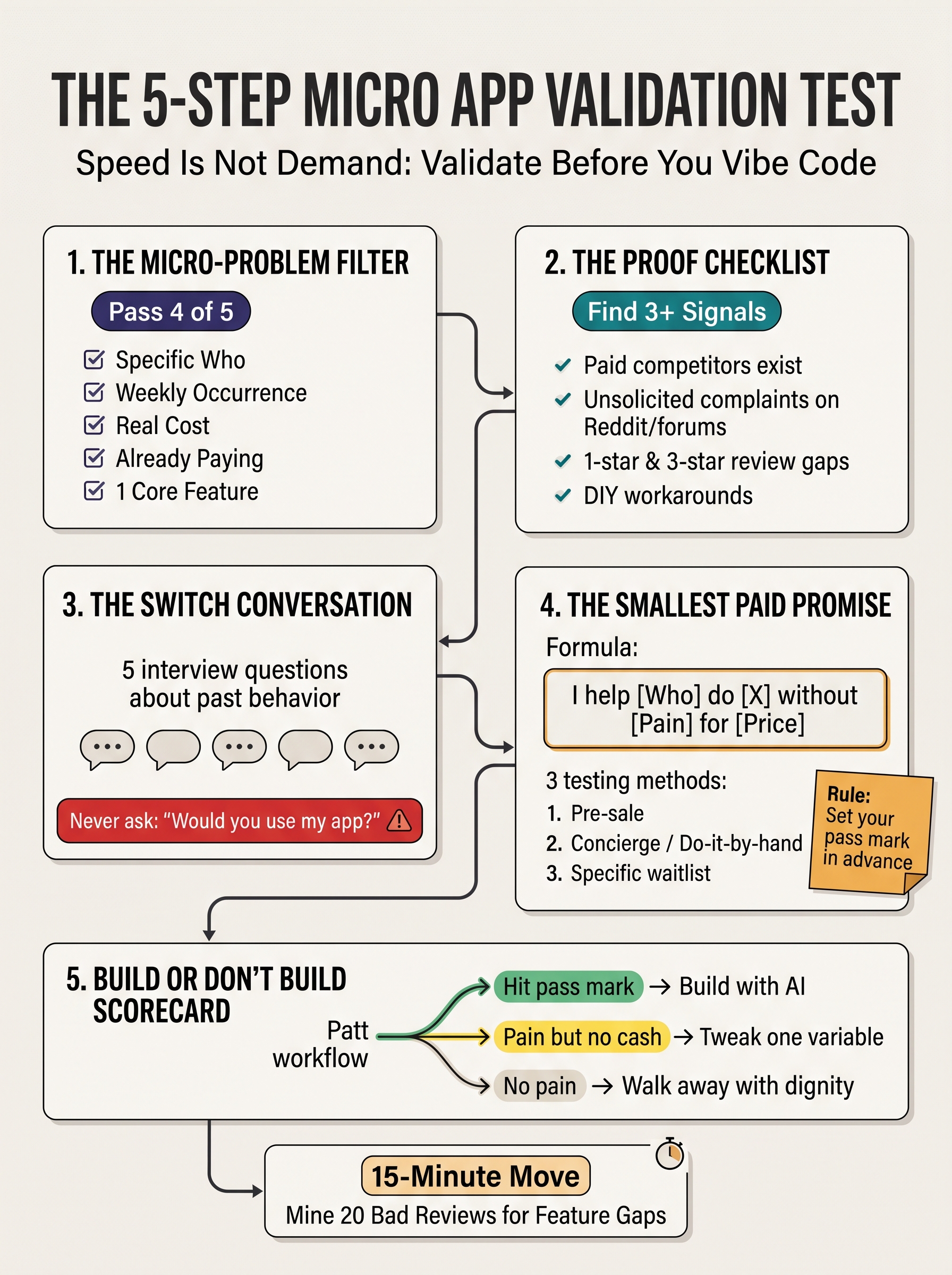
The 5-Step Micro-App Validation Test
To avoid building in a vacuum, run your concept through this five-step validation sequence. It requires a couple of evenings rather than several months.
Step 1: The Micro-Problem Filter
Beginner software concepts are frequently too broad—such as "an app to help small businesses stay organized." A micro-app must solve one sharp, painful problem for one clearly defined user.
Evaluate your idea against these five criteria (aim to pass at least four):
-
Specific Audience: Who has the problem? Identify a precise role or situation (e.g., youth cheer coaches managing 12 parents, or dog groomers booking via SMS), not generic "consumers."
-
Frequency: Does the issue occur frequently (weekly or daily)? Annual pain points rarely sustain recurring subscriptions.
-
Quantifiable Cost: Does it cost them time, money, lost revenue, or embarrassment? Mild annoyances do not generate software budgets.
-
Existing Spend: Are they already paying for alternative software, virtual assistants, or clunky templates to solve it?
-
Single-Feature Scope: Can one core feature resolve the bottleneck? If it requires ten features to be viable, shrink the scope.
Founder Esme Young summarizes this with a clean test:
"I want to build an app that does [X] to solve [Y] problem for [these users]."
If you cannot complete those three inputs clearly, you are not ready to open an IDE. You can use AI as a sparring partner to brainstorm 20 recurring administrative pains within a niche, but real people must verify them.
Step 2: The Proof Checklist
Do not rely on personal opinions; search for objective evidence. Tangible market proof always costs someone time or money. Look for three or more of the following indicators:
-
Active Competitors: Paid apps exist on Product Hunt or the app stores with high review counts.
-
Unsolicited Complaints: Unprompted threads on Reddit, niche Facebook groups, or community forums where users describe the exact issue.
-
Competitor Review Gaps: 1-star reviews show what users despise; 3-star reviews reveal features users liked but felt were incomplete. That functional gap is where your app belongs.
-
Search Intent for Alternatives: Users searching Google for
"[Competitor] + alternative"indicate active buyer dissatisfaction. -
Homemade Workarounds: Community members sharing complex spreadsheets or multi-step manual processes to bridge a workflow gap.
Warning: Finding zero competitors and zero complaints rarely indicates an open highway. More often, it represents an empty road for an economic reason you have not yet uncovered.
Step 3: The Switch Conversation
Talk directly with 5 to 10 individuals who match your target persona. Approach them respectfully in the communities where they discuss their work, without pitching or self-promoting.
Focus entirely on past behavior rather than hypothetical futures. When asked about the future, people are polite; when asked about past actions, they tell the truth.
Use these five interview questions:
-
"Walk me through the last time this problem happened." (Reveals frequency and urgency).
-
"What do you use right now to deal with it?" (Identifies existing tools or workarounds).
-
"What do you hate about that solution?" (Pinpoints genuine friction points).
-
"What have you already tried that didn't work?" (Highlights failed alternatives).
-
"What would a solution have to do for you to switch?" (Uncovers your core differentiator).
The Question to Avoid: Never ask, "Would you use an app that does X?" It costs prospective users nothing to say yes, making their positive feedback commercially meaningless. Look instead for genuine emotional energy, frustration, or unprompted mentions of what they currently pay.
Step 4: The Smallest Paid Promise
You can validate financial demand before building software by crafting a Smallest Paid Promise. Structure it in a single sentence:
"I help [specific person] do [one specific task] without [major pain point] for [price]."
Example: A messaging utility that lets youth cheer coaches confirm parent attendance with one text, avoiding 12 manual follow-ups, for $5/month. (100 active coaches yields $500 MRR).
Test this promise using one of three low-friction methods:
-
The Early Access Pre-Sale: A one-page site displaying the core promise, interface mockups, price, and a payment processor link. State clearly that the software is in development with a defined launch date, backed by a full refund guarantee if it fails to ship.
-
The "Do-It-By-Hand" Test: Deliver the end result manually for a modest fee for a few weeks (concierge MVP). If customers will not pay you to solve it manually, they will not pay for software to automate it.
-
The Specific Waitlist: If taking early payments is not feasible, collect email signups for an early-bird founder discount. Avoid generic "subscribe for updates" forms.
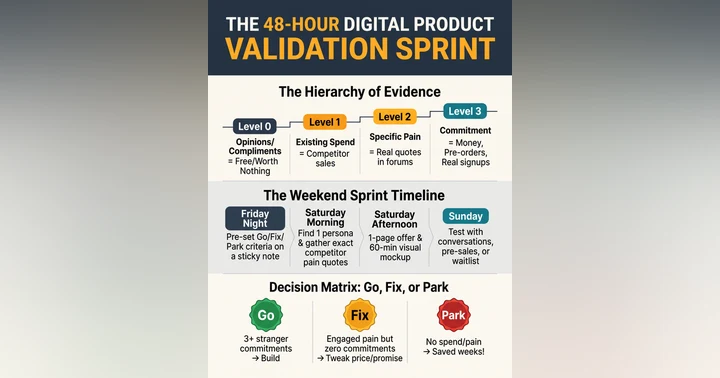
Set Your Success Threshold First: Before launching your test, write your passing criteria on a physical note (e.g., "If 3 unaffiliated coaches pay or formally commit within 14 days, I build"). Establishing the threshold in advance prevents shifting the goalposts when numbers fall short.
Step 5: The Build or Don't Build Decision
After two weeks of testing, compare your results against your benchmark note:
-
Goal Met: Build immediately. You now possess validated customer language for your marketing copy, a clear single-feature roadmap, and paying users waiting for launch. This is where AI tools like ChatGPT, Claude, and Lovable excel.
-
Interest but No Purchases: Re-evaluate the offer. Adjust only one variable at a time—the price point, the target audience, or the core feature—and retest.
-
No Pain Identified: Shelve the concept. Document what you learned and move to the next idea.
Walking away from an unvalidated idea is not a failure; it protects weeks of time and resources that would have been wasted on an unsellable product.
3 Ground Rules for Sustainable AI Micro-SaaS
-
Treat Income Claims as Case Studies, Not Forecasts: Treat public revenue claims on YouTube as individual stories rather than reliable forecasts.
-
Avoid Growth Hacks That Risk Credibility: Avoid artificial upvotes or community manipulation. Long-term software businesses rely on developer reputation.
-
Keep Humans in the Decision Loop: AI functions exceptionally well as a brainstorming partner, copy polisher, and code generator. However, AI is not a customer—do not substitute synthetic data for real human purchasing intent.
The 15-Minute Action Plan
To start immediately without overcommitting time:
-
Identify the primary software competitor in your intended space.
-
Read 20 of their recent 1-star and 3-star customer reviews.
-
Extract quotes where users describe missing functionality or daily friction.
Those complaints highlight the exact reasons existing customers are ready to switch.
Frequently Asked Questions
Can you build a profitable app using only AI tools?
Yes. AI coding assistants (such as Claude, ChatGPT, Cursor, and Lovable) can generate fully functional web and mobile applications. However, profitability depends on solving an acute problem for a paying customer, not the code generation tool itself.
What is the biggest mistake founders make when building AI apps?
The most frequent mistake is building the complete application before verifying willingness to pay. AI makes initial development fast and inexpensive, which often tempts founders to write code before confirming that users are dissatisfied with existing solutions.
How do I know if an app idea is worth pursuing?
An idea shows commercial promise when prospective customers already spend time or money working around the problem, express active frustration with current tools in reviews or community forums, and commit funds or join a specific paid waitlist before launch.
What is the "Smallest Paid Promise" in software validation?
The Smallest Paid Promise is a single-sentence value proposition stating the target user, the specific task solved, the friction removed, and the price point. It allows founders to pre-sell or manually deliver a solution to test real financial demand before development.
This article is based on insights and frameworks shared by the Dark Horse Entrepreneur podcast. For the full breakdown and founder discussion, watch the original video:
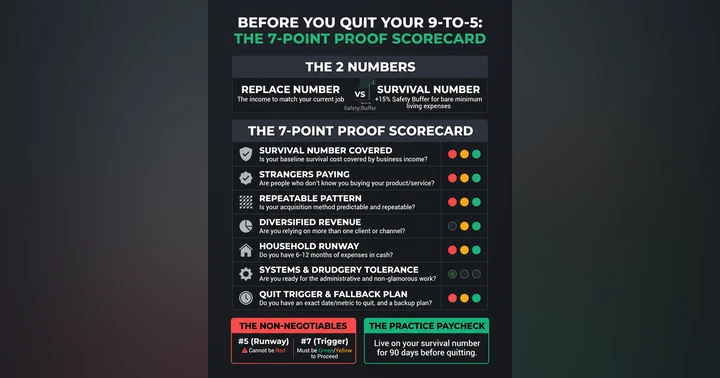
When to Quit Your Job for a Side Hustle 7 Proof Points