The 48 Hour Digital Product Validation Plan
Don’t Build Anything Until You Do This: The 48-Hour Digital Product Validation Plan
By Tracy Brinkmann
TL;DR
AI tools make it easy to generate digital products in a few hours, but speed of creation does not prove market demand. True validation requires real customer commitment—time, attention, or money—before you spend weekends building. By defining go/fix/kill thresholds on Friday and gathering raw customer evidence over Saturday and Sunday, you can confirm whether an offer has paying buyers or save yourself weeks of wasted effort.
Validate Digital Products in a Weekend (Step-by-Step Guide)
Generative AI tools like ChatGPT have made it dangerously easy to package an ebook, template pack, or mini-course in a single afternoon. Yet, an uncomfortable truth remains: rapid creation does not equal customer demand.
Too many entrepreneurs spend six weekends, shell out money for software tools, and pour their energy into a product, only to meet deafening silence on launch day. If strangers never wanted the offer in the first place, building faster only accelerates failure.
To succeed, you must reverse the traditional sequence. Your idea must earn its right to exist before you create it. In this guide, based on the practical framework shared by Tracy on the Dark Horse Entrepreneur podcast, you’ll discover a step-by-step weekend validation plan to find real market proof, test an offer with live buyers, and decide whether to greenlight, refine, or shelve your project before you waste time building the wrong thing.
Key Takeaways
Compliments Are Not Evidence: Polite encouragement ("I’d totally buy that!") costs nothing and predicts nothing. Meaningful validation always costs the buyer time, attention, reputation, or money.
Pre-Determine Your Metrics: Decide your "Go, Fix, or Kill/Park" thresholds on Friday evening so you don't grade your results on a curve later.
Specificity Wins: Avoid vague audiences like "busy professionals." Target a narrow avatar (e.g., solo bookkeepers losing hours chasing receipts) with a concrete, priced deliverable.
Build a Mockup, Not the Product: Highlighting a visual preview—such as a sample page, checklist cover, or dashboard screenshot—gets real reactions in under 90 minutes.
Killing an Idea Is a Win: Deciding to park a non-viable concept in 48 hours saves weeks of unproductive work.
The Trap: Why Compliments Are "Level 0"
When you share an idea with friends or peers, they often respond with enthusiasm: "I would totally buy that!"
While well-meaning, that feedback holds zero commercial value. People are polite, and future promises cost nothing to make. For true validation, evidence must cost the prospect something tangible.
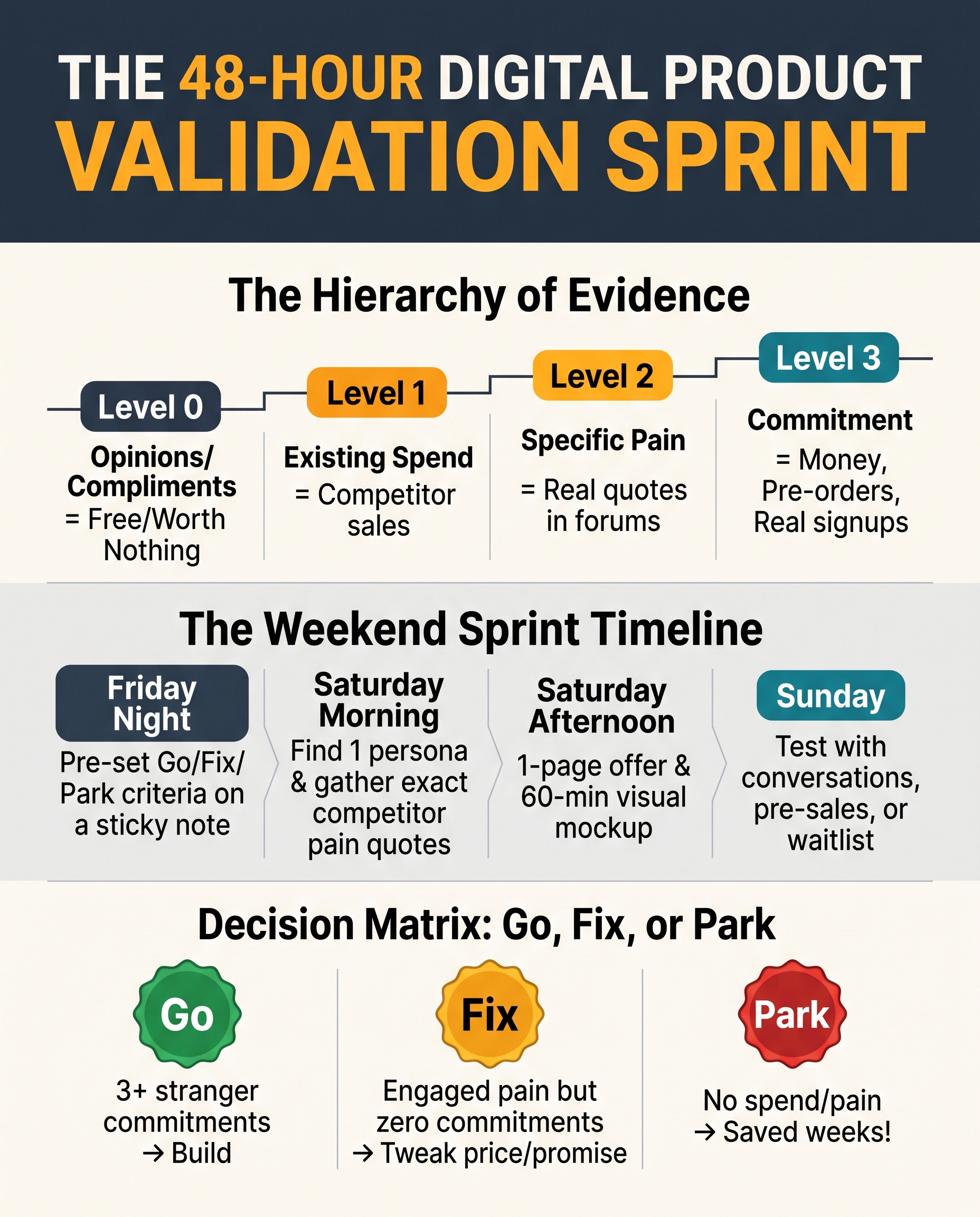
Tracy categorizes validation into four clear levels:
-
Level 0: Opinions & Compliments (No Value): Casual praise, likes, or hypothetical promises. These don't belong on your decision scoreboard.
-
Level 1: Existing Spend: Evidence that prospects are already spending money on solutions nearby (e.g., competitor templates, books, software, or coaching on Etsy, Gumroad, Stand Store, or Amazon). Competition is positive proof of an active marketplace.
-
Level 2: Specific Pain in Their Own Words: Unprompted forum comments, Reddit posts, negative competitor reviews, or direct conversations describing an acute headache (e.g., "I've wasted three Sundays trying to set this up").
-
Level 3: Hard Commitment: The gold standard. A prospective buyer pre-orders, pays, books an exploratory call, or joins a hyper-specific product waitlist.
Friday Night: Establish Your "Go, Fix, or Kill" Rules
Before you run any tests, write your success metrics down on a sticky note. Setting pass marks in advance prevents you from moving the goalposts when the data comes in.
+--------------------------------------------------------------------------+
|                       FRIDAY NIGHT DECISION THRESHOLDS                  |
+--------------------------------------------------------------------------+
|  GO         | 3+ strangers make a firm commitment (pre-orders, payments,  |
|             | or 1 paid pre-order paired with multiple strong interviews).|
+-------------+------------------------------------------------------------+
|  FIX        | High engagement and validated pain, but zero purchases.     |
|             | (Adjust the headline promise, scope, or price point).       |
+-------------+------------------------------------------------------------+
|  KILL/PARK  | No existing spend found and no real pain articulated.       |
|             | (Shelve the idea immediately; you just saved weeks of work).|
+--------------------------------------------------------------------------+
The 10-Minute Friday Night Sanity Check
Before going to sleep, open your notes app and write down these two sentences:
-
"I believe [target buyer] will pay [price] for [specific result]."
-
"The evidence that would prove me wrong is [specific threshold]."
Most creators only seek confirmation bias. Explicitly stating what will prove you wrong turns assumptions into an objective test.
Saturday Morning: Nail the Avatar and Mine the Pain
A viable digital product is never aimed at "beginners" or "people who want to save time." A crowd is not a buyer persona.
A strong persona requires three distinct components:
-
Who they are
-
What situation they are facing
-
What that situation is actively costing them
Weak Persona: A productivity template for busy people.
Strong Persona: Solo bookkeepers who lose two hours every month-end chasing client receipts.
Gathering Level 1 and Level 2 Proof (2 Hours Max)
Dedicate Saturday morning to qualitative research:
-
Examine Competitor Marketplaces: Search Gumroad, Etsy, Teachable, and Amazon. Look for existing sales counts, ratings, and customer reviews.
-
Inspect Negative Feedback: Look at 1-star and 3-star reviews of competing products. One-star reviews reveal what users despise; three-star reviews reveal the missing gaps that buyers wished were included.
-
Harvest Verbatim Quotes: Comb through Reddit, specialized forums, and YouTube comment sections. Copy their exact phrasing into a blank document without paraphrasing. You can prompt an AI assistant to categorize these raw excerpts by theme, but never let AI invent customer pain points for you.
By lunchtime, ensure you can point to existing marketplace spend and at least five distinct examples of potential buyers describing the exact problem in their own words.
Saturday Afternoon: Draft the One-Paragraph Offer and Visual Mockup
You don't need a finished product to gauge buyer intent, but you do need an unambiguous offer that answers four basic questions:
-
Who is it for? (Your precise persona)
-
What result does it deliver? (Phrased using your customers' exact words)
-
What concrete assets will they get? (e.g., "A 12-page checklist and three email templates" beats "A complete productivity system")
-
What is the price? (Assign an actual dollar value; free downloads only measure passive curiosity, not buyer intent)
Example: The Micro-Offer
"The Month-End Receipt Rescue Kit for solo bookkeepers tired of chasing client receipts. Includes 3 copy-and-paste client email sequences, a receipt request checklist, and a one-page policy for onboarding new clients—built to cut your month-end chase time. Price: $19."
Step 4: The 60-Minute Mockup
This is the step most creators skip. People don't buy abstract concepts; they buy what they can visualize.
Spend 30 to 90 minutes building a sample cover image, a screenshot of a single template, or an annotated table of contents. Place this visual mockup on a simple landing page alongside your offer paragraph, the price, and an order button.
+---------------------------------------------------------------+
|                      ETHICAL PRE-SALE RULES                   |
|                                                               |
|  1. State Delivery Dates Clearly: Explicitly note that the    |
|     item is a pre-sale and cite the exact ship date.          |
|  2. Offer a 100% Refund Guarantee: If you fail to hit your    |
|     minimum threshold to build, refund buyers instantly.     |
+---------------------------------------------------------------+
Sunday: Drive Targeted Traffic and Ask for Commitment
On Sunday, take your landing page directly to people who match your buyer persona. Choose one of three distribution paths:
                  CHOOSE YOUR SUNDAY VALIDATION PATH
                                   |
         +-------------------------+-------------------------+
         |                         |                         |
         v                         v                         v
   [Path 1: Direct]          [Path 2: Pre-Sale]       [Path 3: Waitlist]
  DM 10-20 qualified        Drive targeted clicks     Use a hyper-specific
  prospects; ask about      to a checkout page with   list ("Get kit at
  past problems, then       a specified ship date     launch price") if you
  share the mockup/link.    and refund policy.        aren't ready for pre-sales.
1. Direct Qualitative Outreach
Reach out to 10–20 prospects inside relevant communities or professional networks. Respect platform rules by leading with an inquiry rather than a sales pitch:
"I'm putting together a small kit for solo bookkeepers on month-end receipt chasing. Would you be open to a quick chat on how you handle this right now?"
In the chat, ask about past actions, not future possibilities:
-
"When was the last time this issue came up?"
-
"What did you try to fix it, and what did that cost you?"
At the end of the discussion, show the mockup and state the price. If they express interest, share the link so they can commit immediately.
2. The Direct Pre-Sale Page
Direct traffic from your personal profiles, community threads (where permitted), or existing newsletter readers to your checkout page. A handful of strangers entering credit card details is indisputable proof of commercial intent.
3. The Dedicated Micro-Waitlist
If you are uncomfortable charging immediately, use a gated email capture form. Make sure the call to action is narrow and specific: "Join to get the Receipt Rescue Kit at the launch discount when it goes live." Avoid vague lead magnets like "Subscribe to my newsletter."
Sunday Evening: Tally the Score and Make the Call
Review the sticky note you wrote on Friday night. Total your pre-orders, direct inquiries, and concrete sign-ups, then pick your path forward:
-
The "Go" Decision: You hit your threshold (e.g., three paying strangers). Start creating immediately. Your document of customer quotes now serves as your product outline.
-
The "Fix" Decision: People verified the pain point, but nobody converted. Keep the underlying problem, but modify one variable next weekend—tweak the price point, sharpen the headline promise, or narrow the avatar.
-
The "Kill or Park" Decision: No verified pain, no competitor spend, and no buyer interest. Log what you learned, archive your notes, and move on to a fresh problem.
In my view, walking away from an unvalidated concept isn't an entrepreneur failure—it is the single highest-ROI outcome a 48-hour test can produce. You dodge months of unseen production drag and walk away with clean market data.
Critical Realities to Keep in Mind
-
Small Sample Sizes Are Noisy: Validating three pre-orders over a weekend doesn't mean you will effortlessly scale to 300 next month. It simply confirms you’ve cleared the ground-level bar to justify production.
-
Third-Party Revenue Reports Aren't Your Benchmark: Big creators posting six-figure screenshots are reporting their operational outcomes, not your baseline. Focus solely on the data your specific offer produces.
-
AI Is a Draft Assistant, Not a Customer: Large language models are handy for categorizing data and brainstorming angles. They cannot buy your goods, nor can they substitute for speaking with real human buyers.
Frequently Asked Questions
What is digital product validation?
Digital product validation is the process of confirming that an audience wants and will pay for a digital product before you create it. It relies on concrete evidence—such as pre-orders, paid deposits, or customer interviews—rather than casual opinions or assumptions.
How can I test a digital product idea before creating it?
You can validate an idea in 48 hours by identifying a specific problem, finding proof that people already spend money on similar solutions, drafting a single-paragraph offer, creating a visual mockup, and testing pre-orders or specific waitlist sign-ups with real buyers.
Is taking pre-orders for an unmade digital product ethical?
Yes, provided you are fully transparent. Clearly state on your page that the item is currently on pre-sale, give an exact fulfillment date, and offer an immediate 100% refund if you decide not to launch the finished product.
What should I do if my digital product fails validation?
If prospective buyers validate the pain but do not commit, tweak a single variable (such as the price, guarantee, or primary promise) and re-test. If there is no documented customer pain or existing market spend, park the idea and test a different problem.
Next Steps
Before you write your next outline, build another slide deck, or generate assets with AI, give your concept an honest field test. Run this 48-hour plan over the coming weekend and let real market demand guide your schedule.
Source and inspiration:
Weekend AI Digital Product Validation