Sept. 22, 2026
The Secret Behind the AI Scam Crackdown: Don't Let This Happen to You
TL;DR
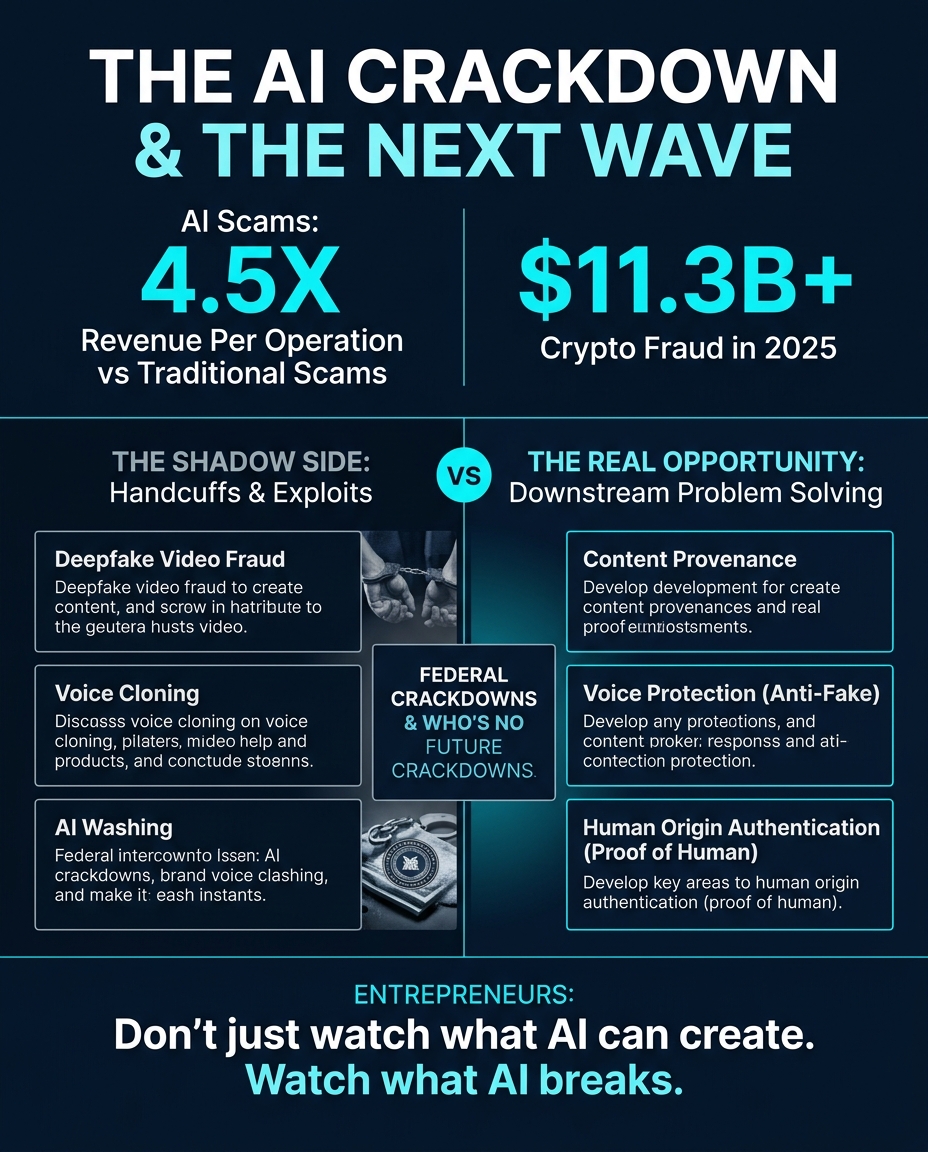
Law enforcement agencies worldwide are aggressively targeting AI-enabled fraud, handing down decade-plus prison sentences for illicit automation, impersonation, and "AI washing." Malicious actors using tools like WormGPT or voice-cloning exploits generated 4.5 times more revenue per attack than legacy scammers, prompting massive federal task forces like Operations Level Up and Winter Shield. For micro-business owners and creators, the real long-term wealth opportunity is not exploiting AI shortcuts, but solving downstream problems—specifically content authentication, human verification, and legitimate workflow automation.
The Secret Behind the AI Scam Crackdown: Don't Let This Happen to You
By Tracy Brinkmann
The promise of artificial intelligence has sparked an unprecedented gold rush. Entrepreneurs, freelancers, and small business operators are leveraging large language models (LLMs) to streamline workflows, scale client deliverables, and launch lean micro-businesses.
Yet alongside this rapid adoption runs a dangerous undercurrent: individuals attempting to turn automation into illicit shortcuts. The boundary separating aggressive digital automation from federal cybercrime is far thinner than many realize. Across 2025 and 2026, global authorities shifted from passive monitoring to direct operational disruption. If you are building an AI-assisted business, understanding the scope of this crackdown is essential to staying protected, remaining compliant, and capitalizing on the legitimate markets emerging in its wake.
Key Takeaways
The Industrialization of Malicious AI
The criminal abuse of generative models began almost immediately after ChatGPT debuted in late 2022. By early 2023, Europol had already cautioned that bad actors were deploying LLMs for cyber attacks and social engineering.
What began as prompt workarounds rapidly consolidated into underground commercial platforms:
- WormGPT (Mid-2023): Recognized as an early commercial malicious LLM, fine-tuned on malware and phishing corpora from the open-source GPT-J model, with licenses selling for $60 to $700.
- FraudGPT: Built explicitly for dark web syndicates, structured around monthly ($200) and annual ($1,700) SaaS subscription models.
- GhostGPT & Dark Web LLMs (2024–2025): Offerings like GhostGPT moved to accessible consumer channels like Telegram, while services like Dig AI operated through Tor with zero logs or filtering safeguards.
Threat intelligence analysts noted this development effectively flattened the barrier to entry: technical programming knowledge was no longer required to deploy automated exploits at scale.
Traditional Scams vs. AI-Driven Attacks:
├── Tooling: Manual scripts/templates ➔ Fine-tuned malicious LLMs (WormGPT, FraudGPT)
├── Channels: Mass email spam ➔ Hyper-personalized Telegram/dating apps/voice clones
├── Yield: Baseline return ➔ 4.5x revenue generated per operation
└── Enforcement: Reactive tracking ➔ Coordinated DOJ, SEC, FTC & international raids
High-Profile Cases: The Illusion of Digital Anonymity
Those attempting to profit from generative exploits frequently operate under the assumption that decentralized technology or borderless infrastructure makes them immune to prosecution. Recent indictments demonstrate the opposite:
1. The $260M Social Engineering Scheme (September 2024)
Federal agents in Miami apprehended 20-year-old Malone Lamb, who was indicted alongside co-conspirators in connection with a cryptocurrency theft and laundering operation exceeding $260 million. Lamb and his associates impersonated corporate support staff (including Google and exchange representatives), streamed their social engineering intrusions live to peers, and laundered proceeds into luxury assets before law enforcement arrested them.
2. The $25.6M Executive Video Deepfake (January 2024)
In a major corporate fraud case, a finance employee at multinational firm Arup authorized 15 wire transfers totaling $25.6 million after attending a scheduled video conference with the firm’s CFO and fellow executives. Every executive on the screen was an AI-synthesized deepfake matching the likeness and cadence of real corporate leadership.
3. Exploitation Compounds and Forced Labor Raids (2026)
Frontier labs, including OpenAI, uncovered and banned coordinated operational networks operating in regions like Poipet, Cambodia. Operators utilized LLMs to generate multi-language romance, gambling, and investment schemes at scale, with investigators linking compound facilities directly to human trafficking networks.
Federal Crackdowns: From Pig Butchering to "AI Washing"
Global regulatory agencies have initiated sweeping coordinated efforts:
Recent Regulatory & Legislative Milestones:
├── January 2024: SEC, FINRA & NASAA issue joint investor warnings on AI fraud
├── 2025: U.S. Congress enacts the Take It Down Act (non-consensual synthetic media)
├── March 2026: Introduction of the AI Fraud Accountability Act
└── Spring 2026: Multi-nation task forces (Operations Level Up & Winter Shield)
Corporate Accountability: The "AI Washing" Trap
Federal regulators have broadened their focus beyond dark-web hackers to include corporate executives. The SEC and DOJ indicted leadership figures—including the former CEO and CFO of NASDAQ-listed EyeLearning Engines—for wire and securities fraud after they made materially false claims regarding their software's proprietary GPT-4 integrations to artificially inflate enterprise valuations. Both face mandatory minimums of 10 years in federal prison.
Criminal Sentencing Precedents
Enforcement under newer statutes has eliminated legal gray areas:
- Under the Take It Down Act, an Ohio man received a 15-year prison sentence in September 2026 for producing non-consensual synthetic media.
- Coordinated police actions in Dubai and Indonesia dismantled multi-national syndicate rings that had targeted thousands of individuals through deceptive investment platforms.
The Downstream Opportunity: Authentication & Human Provenance
As synthetic voice clones—which require only seconds of source audio to execute convincing family emergency scams—continue to expand, the enterprise response must evolve. Gartner projections indicate that by 2026, roughly 30% of global enterprises will deem traditional single-factor identity verification obsolete on its own.
In my view, tracking these regulatory shifts isn't just about risk mitigation; it reveals where sustainable value is moving.
Instead of asking, "What content can I mass-produce with AI today?" the more lucrative, durable question for an entrepreneur is:
"What did AI just break, and who will pay to fix it?"
Research teams and modern startups are creating viable defensive infrastructure:
- Anti-Fake Audio Distortions: Developed by researchers at Washington University (and recognized by the FTC’s Voice Cloning Challenge), Anti-Fake embeds subtle, imperceptible acoustic distortions into source audio. While indistinguishable to human listeners, these distortions disrupt speech synthesizers, demonstrating an over 95% protection rate against voice extraction.
- Biometric Speech Verification (Origin Story): Rather than attempting to detect synthetic artifacts after the fact, Origin Story checks biological signals (such as vocal fold movement) during vocalization, authenticating human-produced speech with an error rate below 0.004%.
This shift marks the emergence of the Human Provenance Market: verification frameworks, origin certifications, identity protection systems, and content authenticity services.
How Legitimate Creators Can Build Safely
If you operate a business powered by commercial AI tools, your operational foundation must remain transparent and strictly above-board:
- Avoid Grey-Hat Automation: Do not deploy scrapers, unauthorized persona bots, or synthetic impersonation to bypass communication barriers or terms of service.
- Audit Operational Disclosures: Never misrepresent automated workflows as proprietary models or human-delivered labor. Regulators penalize "AI washing" in micro-businesses and public corporations alike.
- Double Down on Verifiable Provenance: Build workflows around authentic human brand equity, verified client checkpoints, and authenticated delivery channels that cannot be trivially mimicked by synthetic software.
Frequently Asked Questions
What is "AI washing," and how are regulators penalizing it?
AI washing refers to the practice of exaggerating or falsifying a company’s artificial intelligence capabilities to deceive investors, customers, or partners. The SEC, FTC, and DOJ now actively investigate these claims, treating false AI representations as actionable securities and wire fraud carrying significant prison sentences.
How do modern AI voice-cloning scams work?
Attackers ingest short audio samples—often scraped from public videos or podcasts—into advanced voice-synthesis software. The system produces a real-time replica capable of mimicking tone and inflections. Scammers use this synthetic audio in urgent scenarios, such as fake kidnapping or bail emergencies, to extract ransom money from victims' families.
What is the primary difference between Anti-Fake and standard deepfake detection tools?
Standard deepfake detection evaluates an existing file after creation to assess whether it is synthetic. Protective systems like Anti-Fake act preemptively: they apply subtle, imperceptible mathematical noise to original human recordings before publication, preventing AI voice synthesizers from extracting viable training features.
Build for the Long Run
The legal boundaries surrounding artificial intelligence are firmly drawn. Shortcuts, unvetted exploits, and deceptive practices lead to account bans, civil litigation, and criminal prosecution. By contrast, leveraging tools like ChatGPT to solve difficult problems, streamline legitimate workflows, and protect customer data represents an exceptional business opportunity.
Study where the technology breaks, deliver authentic value, and establish your brand on verified trust.
Source Material: This analysis is based on reporting and commentary from the Dark Horse Entrepreneur presentation,
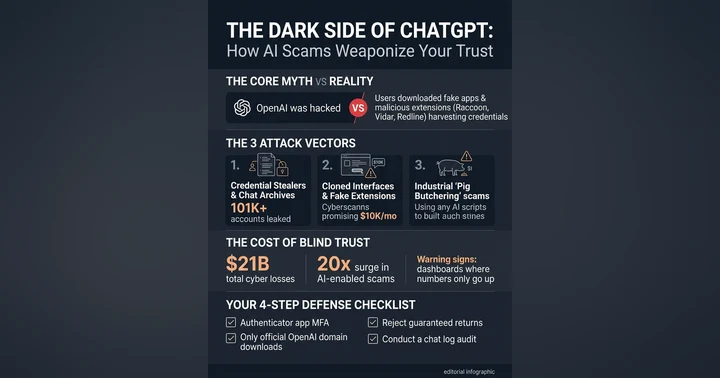
How Hackers Weaponize ChatGPT: Dark Web Breach & Risks
By Tracy Brinkmann How Hackers Are Using ChatGPT Against You: The Dark Web Breach Explained Artificial intelligence has rapidly become the most searched money-making frontier of the decade. Millions of entrepreneurs, remote workers, and curiou…
The First Yes Kit
AI Escape Plan · The First Customer The First Yes Kit Everything you need to start five conversations this week — and turn one of them into your first paying client. Print this. Or keep the tab open. Either way, it takes about twenty minutes …