
Sept. 21, 2026
How Hackers Weaponize ChatGPT: Dark Web Breach & Risks
By Tracy Brinkmann
How Hackers Are Using ChatGPT Against You: The Dark Web Breach Explained
Artificial intelligence has rapidly become the most searched money-making frontier of the decade. Millions of entrepreneurs, remote workers, and curious learners log in daily to streamline workflows or brainstorm business ideas.
Yet, there is a dangerous underbelly to this revolution. Over 100,000 users discovered their credentials compromised, their accounts traded on illicit forums, and their private communications exposed. The threat does not stem from a breach of OpenAI’s core servers—it stems from sophisticated schemes targeting end users directly.
If you are exploring ways to leverage AI tools safely, understanding the mechanisms cybercriminals use to weaponize ChatGPT is vital to protecting your business, finances, and identity.
Key Takeaways
The Scale of the Breach: Inside the Numbers
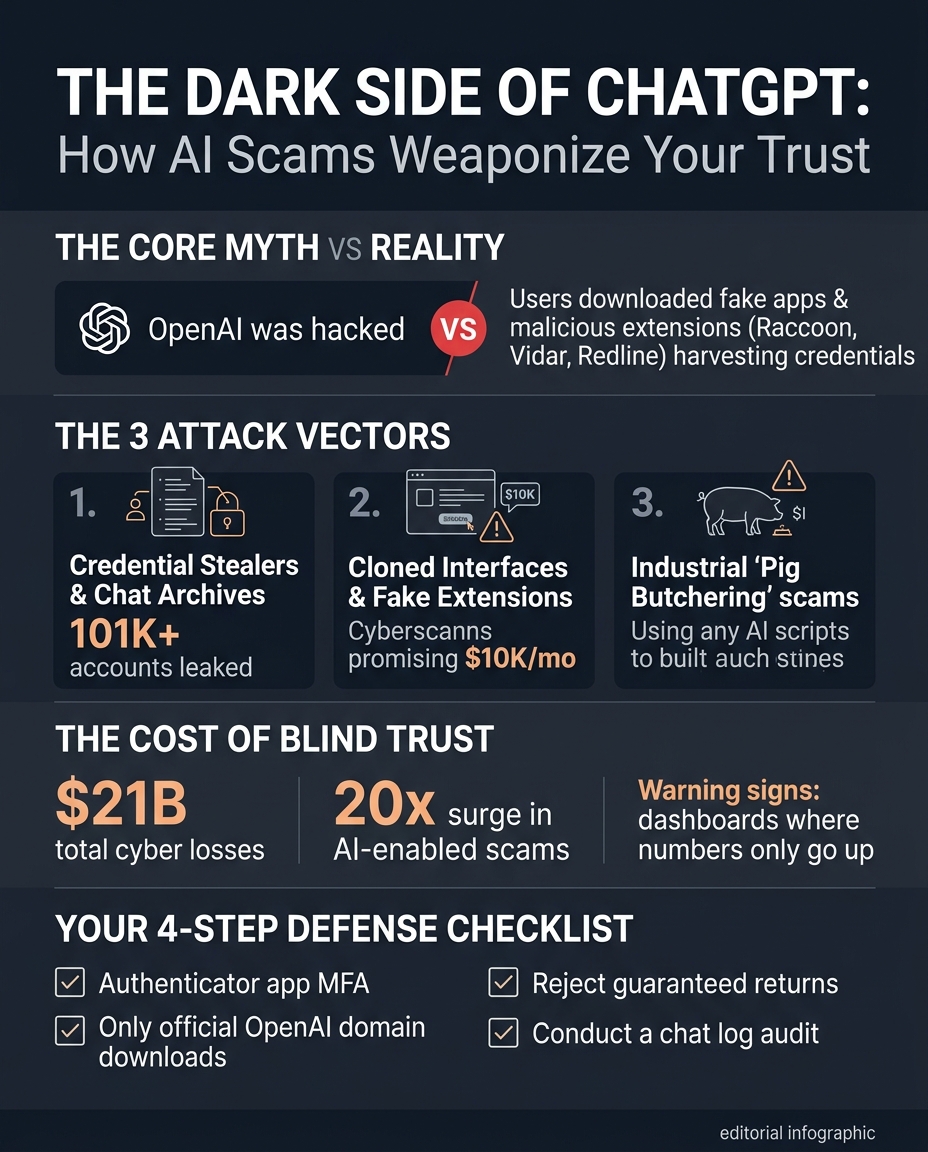
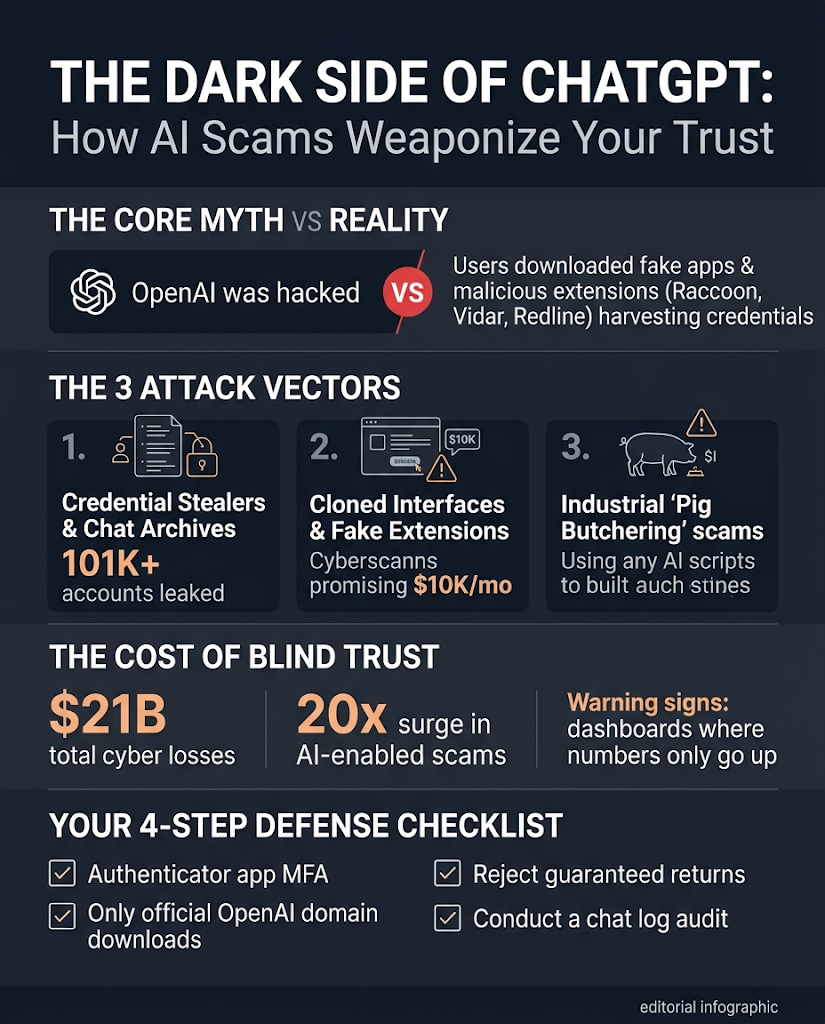
The reality of how ChatGPT accounts are intercepted was detailed by Singapore-based cybersecurity firm Group-IB on June 20, 2023. Their threat intelligence team uncovered 101,034 malware-infected devices containing saved ChatGPT credentials, all circulating on dark web marketplaces.
                      Dark Web Credential Surge
  Total Compromised Devices:       101,034
  Peak Month (May 2023):           ~27,000 credential sets listed
  Top Impacted Regions:            India (~12,500+ accounts), US (~3,000 accounts)
  Primary Single Culprit:          Raccoon Infostealer (~78,000+ cases)
Dmitry Shestakov, Head of Threat Intelligence at Group-IB, clarified that OpenAI’s central infrastructure was not compromised. Instead, users were infected by info-stealers after downloading malicious browser extensions, rogue apps, or falling for phishing traps.
Once malicious software such as Vidar, Redline, or Raccoon—the latter operated by Mark Sokolovsky prior to federal prosecution—infiltrated an endpoint, it scraped everything:
- Stored browser passwords and cookies
- Credit and debit card numbers
- Cryptocurrency wallet keys
- Full browsing histories
Why Compromised ChatGPT Credentials Are Uniquely Dangerous
A leaked password to a generic forum is an inconvenience; a leaked ChatGPT account is an open window into your intellectual property.
Most people treat AI interfaces like confidential sounding boards. Users routinely paste:
- Proprietary software code and application architecture
- Internal financial spreadsheets and projections
- Sensitive customer or client information
- Long-term business growth strategies
Because ChatGPT’s standard configuration retains conversation threads, an attacker who obtains your credentials inherits an unredacted log of your operational thoughts. Threat actors also exploit prompt injection attacks—manipulating live inputs to redirect or extract underlying session data. Your historical chat log ceases to be a working archive and becomes an extortion playbook for the attacker.
In my view, people underestimate this conversational archive; we treat the chat box like a scratchpad, forgetting that every prompt persists until deliberately purged.
The Malicious Ecosystem: Clones, Fake Ads, and Enterprise Impersonation
Cybercriminals do not stop at harvesting individual accounts. They actively construct duplicate ecosystems around the ChatGPT brand.
1. Phishing Portals and Weaponized Extensions
Researchers identified rogue domains such as
chatgpt.online that distributed malware while mimicking legitimate interfaces. Cybercriminals ran social media campaigns, leveraging Facebook pages with official logos to persuade users to install malicious browser extensions. In one widespread campaign, threat actors hijacked 4 million Facebook accounts through fraudulent AI-themed add-ons.2. Rising Attacks on Small Businesses
Cybersecurity firm Kaspersky documented that attacks mimicking ChatGPT jumped by 150%, targeting over 8,500 small businesses with malicious payloads disguised as AI productivity utilities.
3. The "Guaranteed Income" Trap
The operational blueprint follows a consistent funnel:
- An ad or unsolicited email appears with a hook like: "ChatGPT new AI bot has everyone going crazy about it."
- Clicking leads to a counterfeit interface promising daily earnings (e.g., "$10,000 a month").
- After light, scripted interactions, the user is instructed to fund an automated trading vehicle with an entry deposit of $250.
- Once transferred, the capital vanishes immediately into criminal wallets.
The Darker Side: Industrial-Scale "Pig Butchering"
Beyond isolated phishing attacks lies a more severe threat: transnational organized crime networks running industrial "pig butchering" scams powered by AI.
In forced labor compounds throughout Southeast Asia, trafficked workers are coerced into operating systematic fraud rings. Duncan Okindo, an eyewitness to these operations, reported rooms filled with hundreds of captive laborers using the free tier of ChatGPT to script culturally nuanced, persuasive messages targeting Westerners for fraudulent crypto investments. Missing daily performance quotas led to physical violence and electric shocks, while successful thefts were celebrated collectively by compound handlers.
The scale of these operations is staggering:
- Regional Impact: Scam fraud is estimated to generate up to 40% of the combined GDP of Cambodia, Laos, and Myanmar.
- Asset Seizures: In October 2025, federal authorities seized 127,271 Bitcoin (valued at approximately $15 billion) tied to a single network linked to Cambodian compounds.
- Enforcement: International bodies, including Interpol under initiatives like Operation Turquoise, actively target these transnational cyber fraud syndicates, whose proceeds have funded high-end luxury assets, private jets, and fine art.
High-Profile Casualties
The devastation reaches both private citizens and financial institutions:
- Margaret Loke: A San Jose widow lost nearly $1 million to an AI-accelerated investment scheme, draining her retirement savings. Ironically, she only discovered the deception when she pasted the details into an authentic instance of ChatGPT, which flagged the scenario as a standard scam sequence—though the funds were already irrecoverable.
- Shan Hanes: The former CEO of Heartland Tri-State Bank in Kansas was drawn into a fraudulent investment portal via WhatsApp. He embezzled personal savings, $60,000 from his daughter’s college fund, $40,000 in church funds, and $47 million from the bank itself. The bank collapsed, inflicting $9 million in investor losses, and Hanes received a 24-year federal prison sentence.
The Broader Crime Trend
The FBI's 2025 Internet Crime Report illustrates the systemic nature of this threat:
- Over 1 million cybercrime complaints filed in a single calendar year.
- Nearly $21 billion in aggregate financial losses.
- A first-ever dedicated AI section tracking 22,364 complaints totaling $893 million.
- Americans over 60 suffering $7.7 billion in total fraud damages (a 37% year-over-year rise).
- Incidents classified as AI-assisted surging 20-fold from 2023 to 2025.
- Deepfake fraud spreading into corporate operations, highlighted by an employee at engineering firm Arup authorizing a $25 million transfer during a conference call where every executive counterpart was an AI-generated digital replica.
How to Protect Your AI Workflows and Accounts
Building a digital business using artificial intelligence requires basic operational security. To shield yourself from credential theft and phishing traps:
- Enforce Robust Multi-Factor Authentication (MFA): Avoid SMS-only confirmation. Use hardware security keys or authenticator apps to counteract automated session-hijacking tools.
- Verify Official Domains: Access services strictly through OpenAI’s official domain (
openai.com/chatgpt.com). Never download third-party desktop wrappers or browser extensions from untrusted repositories. - Reject Up-Only Investment Models: Any dashboard indicating persistent, risk-free returns or demanding upfront capital to "unlock" algorithmic payouts is fraudulent.
- Conduct a History Audit: Log into your primary AI accounts and examine your past month of queries. If your login were accessed right now, consider what trade secrets, financial records, or credentials an attacker could view, and delete threads containing sensitive information.
Frequently Asked Questions (FAQ)
Was OpenAI’s database hacked to leak 100,000 accounts?
No. Group-IB confirmed that OpenAI’s servers remained unbreached. The credentials were harvested directly from end-user devices infected with malware such as Raccoon, Vidar, and Redline.
How do info-stealers target ChatGPT users?
Info-stealer malware infects machines via unauthorized browser extensions, phishing emails, and malicious downloads disguised as AI utilities. Once installed, it extracts saved session cookies, browser logins, and digital wallet keys.
What is an AI pig butchering scam?
It is a financial fraud scheme where attackers build trust with victims over time before convincing them to deposit money onto counterfeit investment platforms. Criminal syndicates now deploy large language models to automate and refine these manipulation scripts at scale.
Can an attacker access my previous ChatGPT conversations if they get my password?
Yes. Because ChatGPT retains conversation history by default, anyone who compromises your account credentials can view past prompts, including any proprietary data, internal code, or financial metrics you entered.
Conclusion
Artificial intelligence offers genuine leverage for modern businesses, but operating safely requires vigilance. The threat does not stem from legitimate technology, but from bad actors capitalizing on misplaced trust, counterfeit apps, and unmonitored credentials.
To explore safe, tested methods for integrating generative AI into your business without falling into scam funnels, audit your account security today and verify every platform you access.
Source and inspiration:
The First Yes Kit
AI Escape Plan · The First Customer The First Yes Kit Everything you need to start five conversations this week — and turn one of them into your first paying client. Print this. Or keep the tab open. Either way, it takes about twenty minutes …

Faceless Business Ideas: Build Profitable Brands Without Showing Your Face
Build in Silence: How to Launch a Profitable Faceless Brand in 2025 Not everyone wants to be an influencer. And you don’t have to be. Today’s online economy rewards builders who solve problems—not those who post selfies. Faceless businesses are thr…