Realistic AI Side Hustle Hours: 4 Ranked by Real Time
Realistic AI Side Hustle Hours: 4 Options Ranked by Actual Weekly Commitment
By Tracy Brinkmann
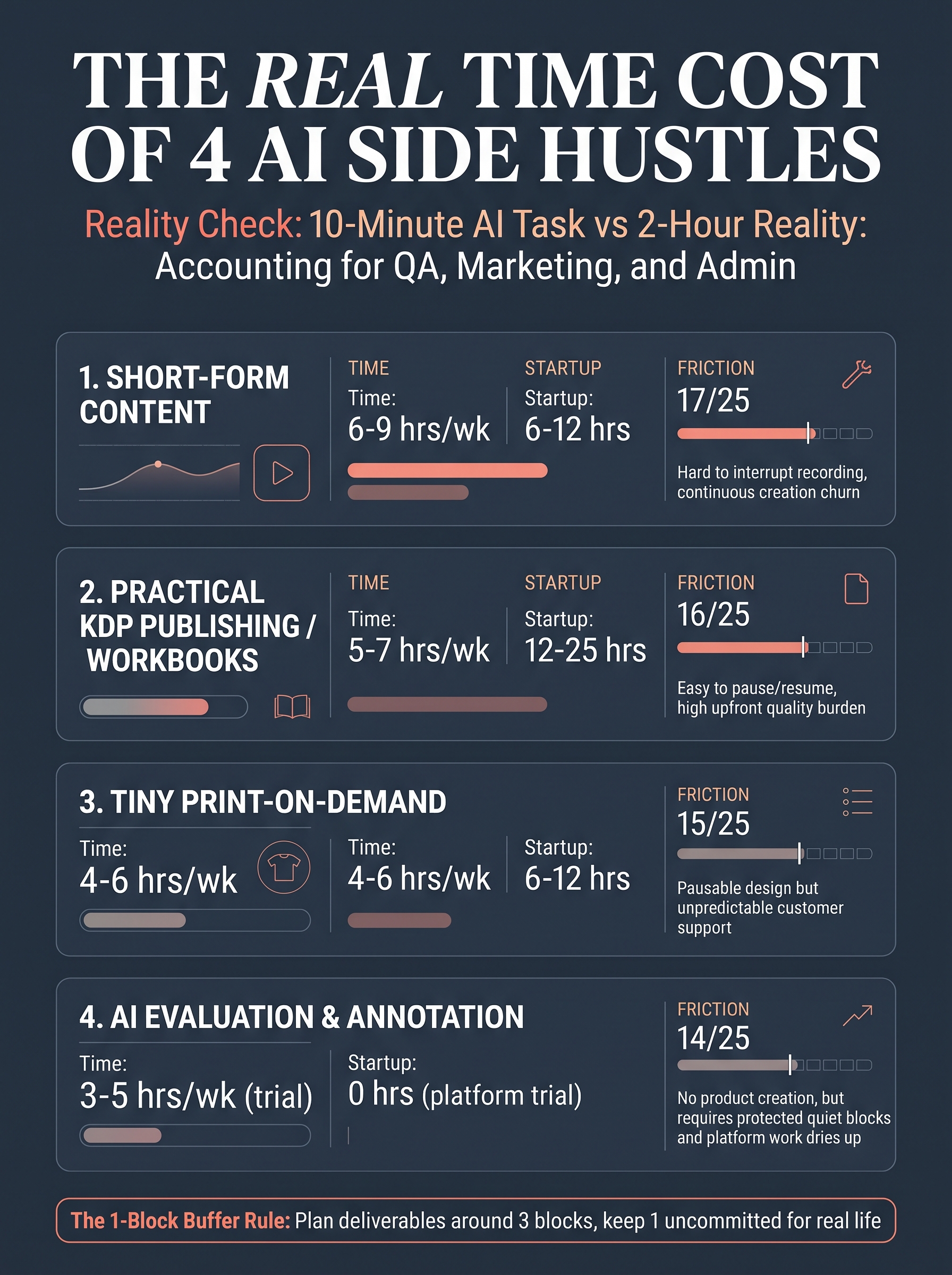
YouTube promises that building a business with artificial intelligence takes "only 10 minutes." While generating a digital draft or product description might take 600 seconds, running an actual business requires finding customers, polishing content, handling support inquiries, and managing administrative tasks.
On episode 568 of The Dark Horse Entrepreneur Podcast, host Tracy Brinkmann dismantles the "10-minute" myth. Drawing on personal tests and real-world experiments covered by creators like Michael Clark, Mike, and Heather, Brinkmann breaks down what happens when you account for the unglamorous work YouTube gurus ignore.
Here is how four common AI-assisted side hustles rank when measured by honest weekly hours, startup buffers, and how easily they tolerate family interruptions.
Key Takeaways
The "10-Minute" Fallacy: A 10-minute AI draft frequently requires 20 minutes of quality checks, 30 minutes of asset fixing, and an hour of customer outreach—turning a tiny task into a 2-hour commitment.
Time Shape Over Total Time: Four hours divided across eight 30-minute bursts functions completely differently than a single 4-hour uninterrupted block.
The 4 Ranked Options by Weekly Time:
AI Evaluation & Annotation: 3–5 hours/week (Lowest ongoing hours; highly dependent on platform project availability and requires quiet focus).
Tiny Print-on-Demand (POD) Offer: 4–6 hours/week (Pause-friendly design; requires ongoing customer support and promotion).
Practical Publishing / Workbooks: 5–7 hours/week (Asynchronous and pausable; demands 12–25 startup hours and manual quality validation).
Short-Form Content Creation: 6–9 hours/week (Highest recurring commitment; recording demands protected quiet windows).
The Buffer Rule: Plan deliverables around 75% of your available time. If you have four work blocks, schedule for three and leave the fourth uncommitted to absorb inevitable life friction.
What Belong on the Clock? The True Math of Side Hustles
When evaluating side hustle time commitments, you cannot count only the generation phase. A realistic weekly time budget must cover:
-
Creation & Editing: Drafting with AI, editing, fact-checking, and correcting assets.
-
Customer Distribution: Setting up listings, finding buyers, and running promotions.
-
Customer Service & Admin: Answering buyer messages, processing fulfillment hiccups, and bookkeeping.
-
Startup Allowances: Dedicated setup hours (learning software, opening accounts) tracked separately from maintenance hours.
In my view, people fail at side hustles not because they lack skill, but because they plan for their best possible week instead of their average week. Life brings unplanned meetings, family chores, and surprise illnesses. Factoring in interruption tolerance is just as vital as tallying raw hours.
4 AI Side Hustles Ranked by Weekly Time Commitment
Brinkmann evaluated each option using a five-factor friction check (scoring startup cost, skill barrier, weekly hours, time to first dollar, and risk from 1 to 5). Ranked below from the lowest ongoing time commitment to the largest:
+-----------------------------------------------------------------------------------+
| Side Hustle Model        | Weekly Hours | Startup Allowance | Friction Score (1-25) |
+-----------------------------------------------------------------------------------+
| 1. AI Evaluation         | 3–5 hrs      | Assessment phase  | 14                    |
| 2. Tiny Print on Demand  | 4–6 hrs      | 6–12 hrs          | 15                    |
| 3. Practical Publishing  | 5–7 hrs      | 12–25 hrs         | 16                    |
| 4. Short-Form Content    | 6–9 hrs      | 6–12 hrs          | 17                    |
+-----------------------------------------------------------------------------------+
1. AI Evaluation and Annotation Work (3–5 Hours / Week)
-
Ongoing Weekly Commitment: 3–5 hours (typically two 90-minute focused sessions, plus admin and qualification checks)
-
Startup Time: Several hours for onboarding tests and assessments
-
Friction Score: 14 / 25
-
Interruption Tolerance: Very Low
AI evaluation work (such as tasks on platforms like Data Annotation, examined by creators Mike and Heather) flips the standard model: instead of using AI to run a business, you evaluate AI models to train them.
-
What the Work Looks Like: Reviewing chatbot responses, comparing quality, catching hallucinations, and annotating data based on strict instructions.
-
The Major Catches:
-
Platform Dependency: You do not own a client base. Available projects can dry up without warning. Refreshing an empty dashboard is unpaid time.
-
Strict Assessments: Getting accepted requires critical thinking and attention to detail.
-
Zero Outside AI: You cannot feed confidential evaluation tasks into external chatbots to cheat the work.
-
Unforgiving with Interruptions: Most tasks have active timers and connection requirements. If family emergencies pull you away mid-task, you risk losing unsaved work.
-
2. A Tiny Print-on-Demand (POD) Offer (4–6 Hours / Week)
-
Ongoing Weekly Commitment: 4–6 hours (approx. 90 minutes for designs, 90–120 minutes for listings/marketing, 1–2 hours for customer service and orders)
-
Startup Time: 6–12 hours (storefront setup, mockup testing, provider integrations)
-
Friction Score: 15 / 25
-
Interruption Tolerance: Moderate to High (designing is pause-friendly; customer support requires set windows)
Print on demand allows you to sell physical products without holding inventory. The secret to keeping this inside a manageable time budget is keeping the scope tiny: one niche, one product type, and a handful of original designs.
-
Where AI Fits: Brainstorming concepts, generating initial art variations, and drafting product descriptions.
-
The Reality Check: Creator Michael Clark's experiments highlight that connecting a print provider to a Shopify store or an Amazon Merch on Demand account does not automatically produce buyers.
-
Key Considerations:
-
Avoid Custom Orders Early: Custom personalizations (e.g., changing names or revising art) destroy your weekly time budget.
-
Customer Care Remains Yours: Even though printing and shipping are outsourced, handling damaged shipments or sizing returns rests entirely on you. Communicate clear, realistic response windows (e.g., "Replies within 24 hours") rather than promising instant replies.
-
3. Practical Publishing and Workbooks (5–7 Hours / Week)
-
Ongoing Weekly Commitment: 5–7 hours (2 hours of quality refinements, 2–3 hours of marketing/discovery, 1–2 hours of feedback and admin)
-
Startup Time: 12–25 hours (formatting, interior layout, cover design)
-
Friction Score: 16 / 25
-
Interruption Tolerance: High (files and layouts can be saved and resumed anytime)
Rather than trying to write a complex novel, practical publishing focuses on targeted, useful tools: a regional gardening log, a specialty practice tracker, or a step-by-step habit workbook via Amazon KDP.
-
Where AI Fits: Brainstorming chapter outlines, identifying missing instructional steps, or spotting gaps in clarity.
-
The Reality Check: AI cannot tell you whether a physical workbook is functionally useful. You must walk through the layout yourself to verify margin spacing, writable lines, and practical utility.
-
Amazon KDP Compliance Rules:
-
AI-Generated Content: If AI created the actual text or images, KDP guidelines require you to disclose it, even if subsequently edited.
-
AI-Assisted Content: Using AI solely for outlining, brainstorming, or proofreading existing text is categorized differently. In either case, legal copyright and image usage rights remain your personal responsibility.
-
4. Short-Form Video Content Creation (6–9 Hours / Week)
-
Ongoing Weekly Commitment: 6–9 hours for a modest schedule of 3 weekly videos (2 hours outlining/research, 2 hours filming/editing, 1 hour captioning/publishing, 1–4 hours audience engagement)
-
Startup Time: 6–12 hours (channel branding, setup, workflow testing)
-
Friction Score: 17 / 25
-
Interruption Tolerance: Low during recording; Moderate during ideation and editing
Creating short-form video on TikTok, YouTube Shorts, or Instagram Reels has a low financial barrier, but it ranks highest in recurring time demand because the production treadmill resets every single week.
-
Where AI Fits: Organizing raw research, refining hooks, and cleaning up auto-generated captions.
-
The Reality Check: Creator monetization bonuses fluctuate constantly. Building a household budget around platform payout programs is risky. A video strategy needs a clear business purpose beyond hoping an algorithm notices you.
-
Practical Constraints:
-
While scripting and editing handle interruptions well, recording requires dedicated quiet blocks and clean audio.
-
You do not need to turn your family's personal life into content. Pick a narrow problem you understand (e.g., garage organization, tool maintenance) and test whether viewer interactions validate true demand before investing in complex equipment.
-
How to Test Your Side Hustle Without Overwhelming Your Schedule
If you want to validate a side hustle without burning out, follow this small-test framework:
-
Pick Exactly One Lane: Avoid opening accounts across multiple models at once. Running four half-baked tests yields zero actionable data.
-
Define a Tiny Output: Limit your scope to a single deliverable—one product concept conversation, one sample workbook page, or a full pass through an annotation platform's application guide.
-
Log All Working Minutes: Track time spent learning, waiting, drafting, fixing errors, and messaging buyers.
-
Apply Whiskered Wisdom (The 75% Rule): Always leave one work session uncommitted. If your week has four open blocks, schedule deliverables into three. Keep the fourth block as a buffer for family interruptions, chores, or revision delays.
-
Evaluate Value Over Praise: Look for evidence of commercial interest (specific problems raised, detailed critiques, or willingness to buy), not just polite encouragement from friends and family.
Frequently Asked Questions
What is the fastest AI side hustle to start with limited hours?
AI evaluation platforms (such as Data Annotation) require the fewest ongoing weekly hours (3–5 hours/week) and eliminate the need to build a store, create products, or pitch clients. However, they require passing rigorous screening assessments, demand focused quiet time, and depend on platform task availability.
How do Amazon KDP rules treat AI content in self-published books?
Amazon KDP distinguishes between AI-generated and AI-assisted material. Creators must disclose if text or imagery was directly generated by AI tools, even if subsequently edited. Using AI to brainstorm structures or correct grammar is considered AI-assisted. The author remains legally responsible for copyright and trademark compliance.
Can you run a print-on-demand side hustle without customer service?
No. While print-on-demand platforms handle physical printing, packing, and shipping, the seller remains responsible for handling inquiries, sizing questions, defective shipments, and return requests. Sellers should publish clear, realistic email response windows to manage customer expectations.
What is the biggest hidden time sink in AI side hustles?
The administrative and quality-assurance phases. Drafting an asset with AI might take 10 minutes, but checking factual accuracy, formatting layouts, uploading files, writing marketing copy, and handling customer messages often expands the task into 2 or more hours.
Protect Your Time, Build with Judgment
AI offers helpful leverage for outlining, drafting, and organizing workflows, but it cannot replace personal judgment or eliminate foundational business tasks. By matching your side hustle model to the shape of your week—rather than squeezing your schedule into unrealistic internet promises—you can make steady, sustainable progress.
To audit your weekly schedule and budget realistic working blocks, reference the tools and insights shared on
7 Fast Pay Side Hustles That Pay You Within a Week